
A Street Called Chilco
Reflections from Vancouver’s West End on place, gratitude, and unceded land

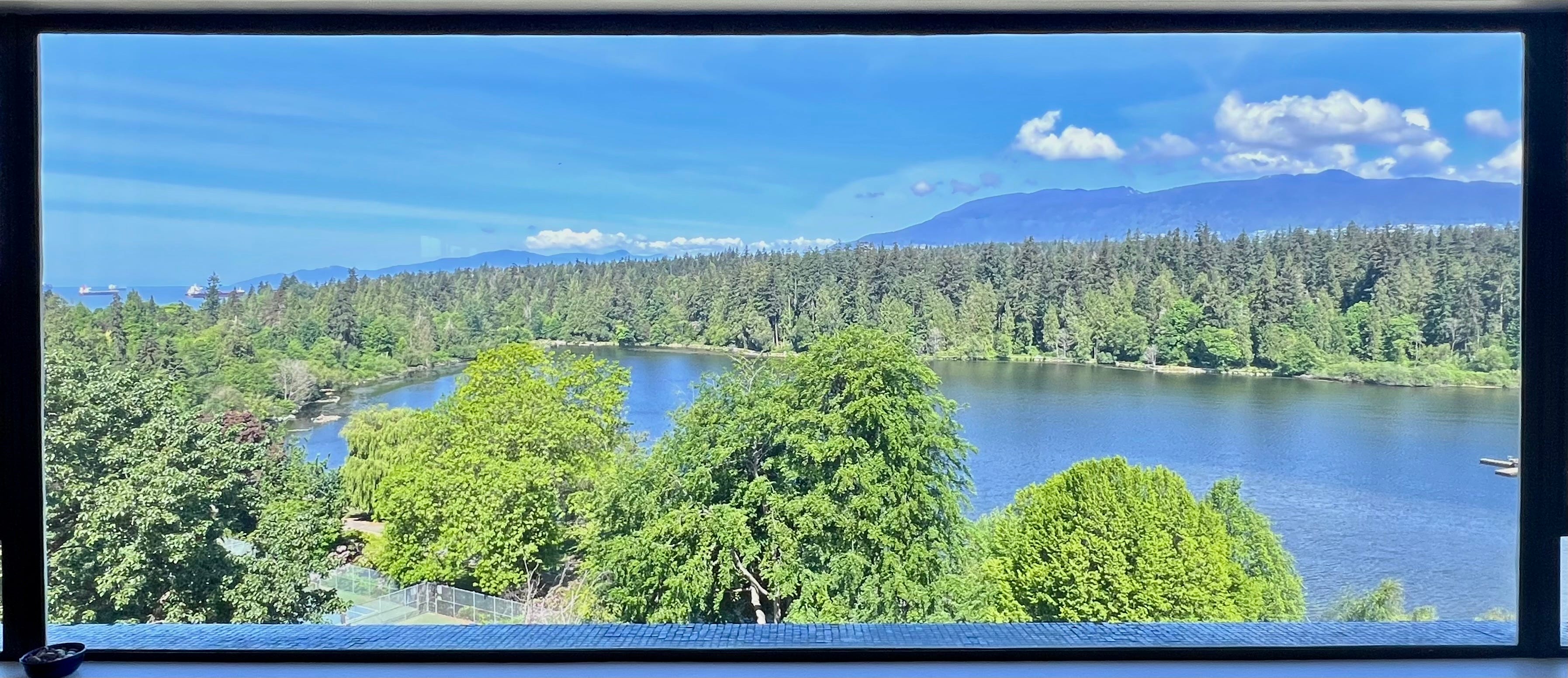
Last month, my wife, Nancy, and I downsized and moved into a 1958 condo, Chilco Towers, on Chilco Street, at the edge of Lost Lagoon overlooking Stanley Park. The building is clad in weathered blue mosaic tiles that make it stand out against the neighboring towers. The apartment itself is modest, but the long window stretching across the living room feels almost like a watchtower over water, trees, and sky.
Every time I walk into the room, it stops me. Seaplanes rise and settle across the harbor all day long. Great blue herons drift past with their slow prehistoric wings. From my perch above Stanley Park, home to one of the largest urban heron colonies in North America, it sometimes feels as though the birds belong to the landscape more fully than the city itself. Cormorants, gulls, ducks, and the occasional eagle move through the light as if keeping an older rhythm than the city below them.
What surprises me is the improbability of it all: forests, mountains, tidal water, and migrating birds gathered at the edge of a global city of glass towers and constant motion. Here on the western edge of the West End, the city can feel less like something imposed upon nature than a negotiated truce between them.
Many of the West End streets were named in the 1880s by Vancouver’s early surveyors and borrowed from BC geography, British naval figures, and politicians. Chilco came from Chilko Lake in the Cariboo region, and early records suggest the name itself comes from the Tsilhqot’in language (“Tsilhqot’in” or “Tsilhqo”), though the exact meaning is debated — often translated as “young man’s river” or “ochre river.”
The street later became known for another reason as well: it was the first street in North America redesigned specifically for traffic calming and neighborhood traffic control—an early attempt to preserve livability by reducing through-traffic and noise, and to reclaim residential streets as places for people rather than simply corridors for cars. It reflected a broader shift in how cities were imagined. Vancouver later became internationally known for this approach, in part because it rejected many of the urban freeway projects that reshaped and divided other North American cities.
The older I get, the more I find myself paying attention to the histories beneath places — not just the visible city of towers, roads, and parks, but the deeper human and ecological stories beneath them. Every time I look out that window, I feel grateful to live in such beauty, on the unceded territories of the xʷməθkʷəy̓əm (Musqueam), Sḵwx̱wú7mesh (Squamish), and səlilwətaɬ (Tsleil-Waututh) Nations.
With the move, Nancy and I no longer carry a mortgage. It felt like a good moment to ask what it means to live more responsibly in a place we did not inherit fairly. We decided it was time to begin contributing, in some modest way, to First Nations communities whose lands were never ceded — not out of guilt alone, but out of gratitude, responsibility, and a desire to belong more honestly to the place that now shelters us.
Beautifully written Bruce. And, as a recent visitor in your home, I found it to be a magical place; a place to know your neighbors, the feel of the Natural World around you, and a lovely place for you and Nancy to grow old together.
Sent with love ❤️ ❤️
Mom
Welcome to a non-stop daily dose of nature in an urban environment, right outside your window.