
An Unwitting Bargain
There is growing evidence that chemical exposure may echo across generations

The harms accumulated slowly enough that we mistook them for progress.
One of the strangest features of modern life is that many chronic diseases seem to be rising together.
Obesity, infertility, kidney disease, metabolic disorders, developmental conditions, earlier puberty, declining sperm counts. Chronic disease is no longer the exception in America. More than three-quarters of adults now report at least one chronic condition, and more than half live with multiple illnesses.
We usually explain these conditions one at a time: poor diet, stress, genetics, inactivity, aging, better diagnosis. Each explanation contains some truth. But what if we are missing a larger pattern? What if at least part of this burden did not begin with individual choices or bad luck, but with the world we have built around ourselves?
That is the unsettling possibility raised by the work of Michael Skinner, whose studies suggest that environmental exposures may leave biological changes that echo across generations.
For most of modern history, we assumed inheritance flowed primarily through genes. DNA was treated as destiny: a stable code passed from parent to child. Skinner’s work suggests something more layered and more fragile. Exposure itself may become biologically embedded.
In one of his best-known studies, pregnant rats exposed briefly to glyphosate—the world’s most widely used herbicide—showed relatively modest direct effects. Their descendants did not. By the second and third generations, rates of obesity, kidney disease, ovarian disease, prostate disease, and birth abnormalities had risen dramatically.
Glyphosate is not the only example. Skinner’s laboratory has reported similar transgenerational effects with fungicides, plastics-related chemicals, dioxins, and jet fuel hydrocarbons. Different chemicals. Similar pattern.
The crucial detail is that by the fourth generation, the descendants were no longer directly exposed to the chemical. That changes the logic of the debate.
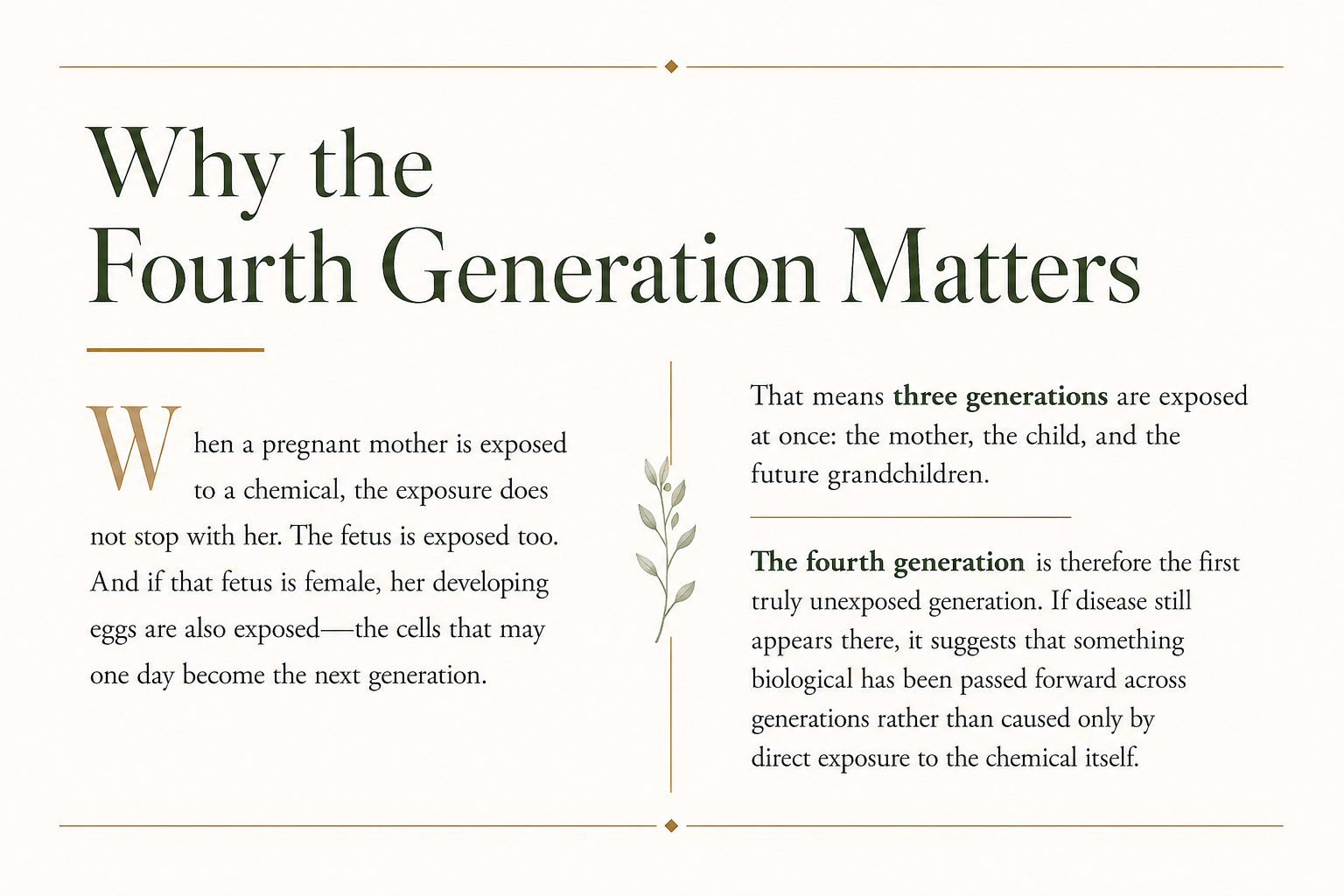
Toxicology has long depended on a relatively straightforward framework: expose an animal, observe what happens, estimate a threshold, establish a “acceptable” level, and move on. But if disease emerges generations later in descendants who were never directly exposed, then something biological—not merely social or behavioral—has been carried forward.
According to Skinner’s work, what is inherited is not a mutation in the DNA sequence itself, but an epigenetic alteration: changes in the molecular markings that regulate how genes are turned on or off. In other words, exposure may leave altered instructions behind.
That possibility is difficult to shake.
We often think of chronic disease as the accumulated consequence of bad luck, aging, or personal choices. But what if part of today’s burden reflects exposures experienced by parents and grandparents long before symptoms appeared? What if some infertility, metabolic disease, reproductive disorders, or developmental problems are not simply individual misfortunes, but delayed biological echoes of environments created decades earlier?
Skinner’s newer work suggests these epigenetic changes may persist not merely for three or four generations, but for twenty generations in experimental animals. Twenty generations is no longer a fleeting biologic insult. It begins to resemble ecological inheritance.
I often think about Disney’s The Sorcerer’s Apprentice when reading these studies. In the story, Mickey Mouse enchants a broom to carry water so he no longer has to haul it himself. At first the magic feels miraculous. The work disappears. The water flows effortlessly.
Then the broom keeps going.
The water keeps rising.
Soon the apprentice is drowning in the very thing he thought he controlled.
The twentieth century often feels like that story. Many synthetic chemicals brought genuine benefits: higher agricultural yields, fewer infectious diseases, more abundant food, improved manufacturing, easier living. Much of modern prosperity was built alongside chemistry.
At first it all seemed miraculous.
But we also released tens of thousands of poorly tested chemicals into the world before understanding how they might interact with fetal development, hormones, metabolism, immune systems, or even the germline itself. The harms accumulated slowly enough that we mistook them for progress—or simply the unavoidable price of modern life.
Now we find ourselves confronting an unsettling question: how much of the chronic disease surrounding us reflects not merely aging or bad luck, but delayed consequences of environments we created before we understood what they could do?
To be clear, these studies do not prove that glyphosate causes a particular disease in humans, nor do they tell us precisely how much modern chronic illness is transgenerational. Animal studies do not automatically translate to people. But the trajectory of the science is becoming harder to ignore.
For decades we viewed inheritance primarily as something encoded in genes. Skinner’s work suggests inheritance may also carry traces of environmental experience—the pesticides, plastics, pollutants, and industrial chemicals woven into modern life.
If that is true, then prevention becomes something larger than regulation or bureaucracy. It becomes an act of stewardship.
Because eventually the question is not simply whether we can engineer another chemical, automate another task, or increase another yield. It is whether we are wise enough to live with what we unleash.
Thank you Bruce, for so clearly introducing a hugely important aspect of toxicology that is gaining recognition.
Even knowing of transgenerational effects, recent studies such as the findings of 20 generations of ongoing epigenetic effects in rats following vinclozolin are particularly disturbing.
Stability of epigenetic transgenerational inheritance of adult-onset disease and parturition abnormalities
https://www.pnas.org/doi/10.1073/pnas.2523071123
I wonder though, is this really is a one-way ratchet? What dramatic changes in environment, activities and diet just might start to undo these changes?
Strict exclusion as much as possible (can't be perfect) of synthetic chemicals of modernity?
Dietary restriction?
Exercise from early life on?
Shielding from the modern radiofrequency exposures [many orders of magnitude greater than a century ago]?
... It's certainly NOT more "hair of the dog."
My partner and I were chatting about a popular article (or maybe substack!) that he read about demographics and declining birth rates last week. I was absolutely shocked that the piece did not mention anything about declining fertility or the role of environmental exposures in that trend.