
Beneath the Surface
What Cornwall's Mines Teach Us About Progress

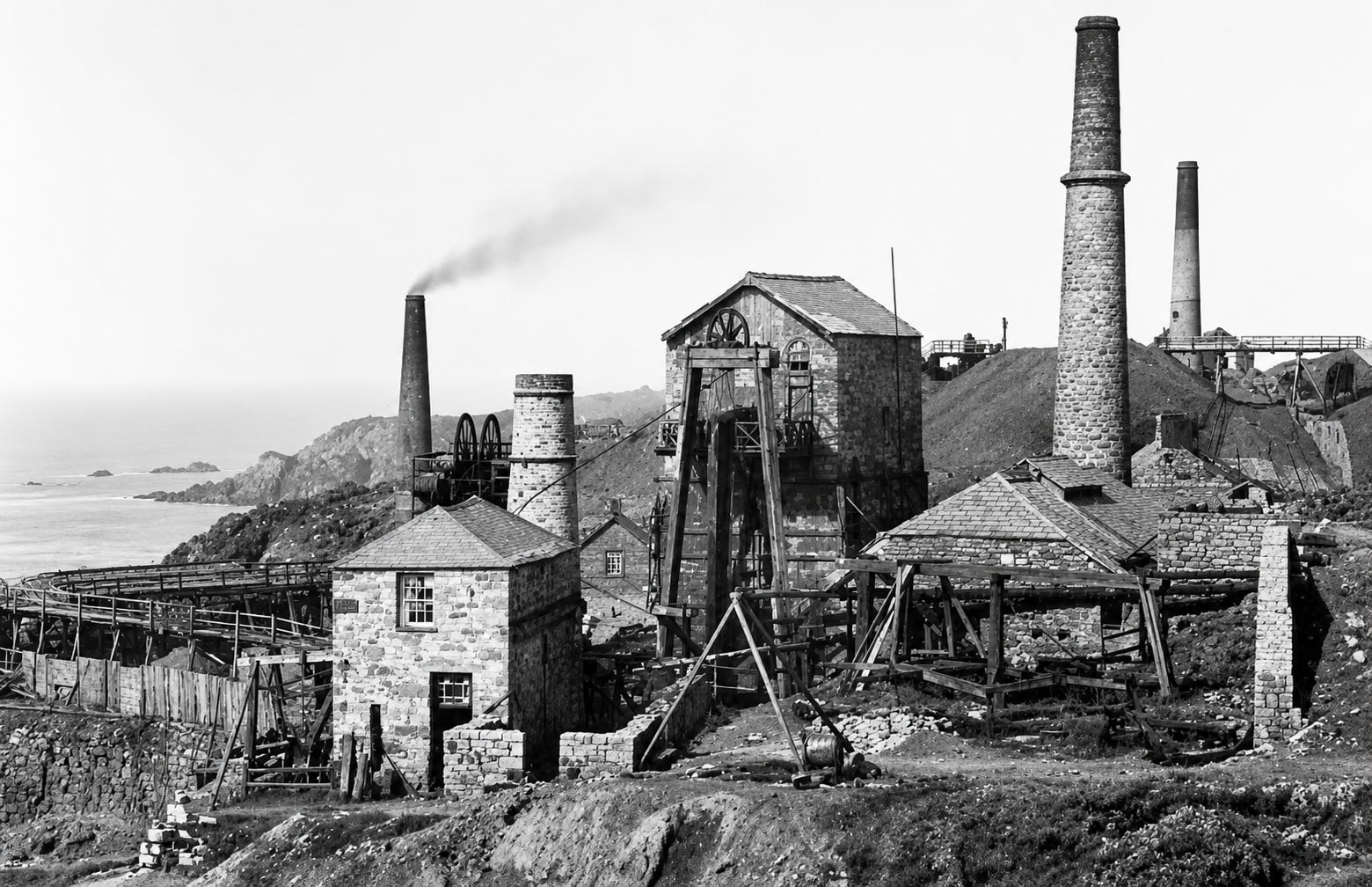
Most people come to Cornwall for the beaches, fishing villages, coastal walks, and dramatic cliffs overlooking the Atlantic. During our visit, however, I found myself drawn to a different attraction.
Over the course of a week, I visited three mining sites: Geevor Mine, Botallack Mine, and the ruins of Trewavas Mine perched above Mount’s Bay. It is an unusual vacation itinerary unless you happen to work in public health.
Nancy accompanied me to Geevor. As we emerged from the underground tour, she said that the experience had made her more grateful for the materials we depend on every day. Tin, copper, and lead helped build the modern world. The electrical wiring in our homes, the solder in electronics, plumbing, machinery, batteries, and countless industrial products all depended on minerals extracted by miners working far below ground.
Her observation captured one of the central tensions of public health. We benefit enormously from technological progress, yet we often overlook the people who bore its costs.
Cornwall’s mining history offers a remarkable window into that trade-off.
The Metal That Changed the World
Cornwall sits atop one of Europe’s richest mineral deposits. For thousands of years, people came here seeking tin, copper, and lead.
Some historians believe Cornwall’s tin deposits were so valuable that they attracted traders from across the Mediterranean long before the Roman conquest of Britain. The Romans certainly exploited Britain’s lead deposits, and Cornwall’s mineral wealth contributed to Britain’s strategic importance.
By the eighteenth and nineteenth centuries, Cornwall had become one of the world’s most important mining regions. At its peak, tens of thousands of people worked in the industry. Men labored underground while women and children often worked above ground sorting and crushing ore. These women were known as “bal maidens,” a term derived from the Cornish word for mine.
Mining shaped nearly every aspect of Cornish life. Entire communities depended on it. Villages, railways, ports, schools, churches, and businesses grew around the mines.
The wealth extracted from Cornwall helped fuel the Industrial Revolution.
The View from Botallack
No site captures this history more dramatically than Botallack Mine.
Its famous Crown engine houses cling to narrow ledges above crashing waves. Looking at them today, it is difficult to imagine that miners once followed ore veins beneath the Atlantic Ocean itself. Some tunnels extended more than a mile offshore beneath the seabed.
The defining feature of Botallack was its submarine mining. By the late eighteenth century, improved pumping technology allowed miners to follow ore veins hundreds of feet beneath the seabed. The famous Crowns engine houses, perched dramatically on the cliffs, were built to pump water and raise miners and ore from these undersea workings.
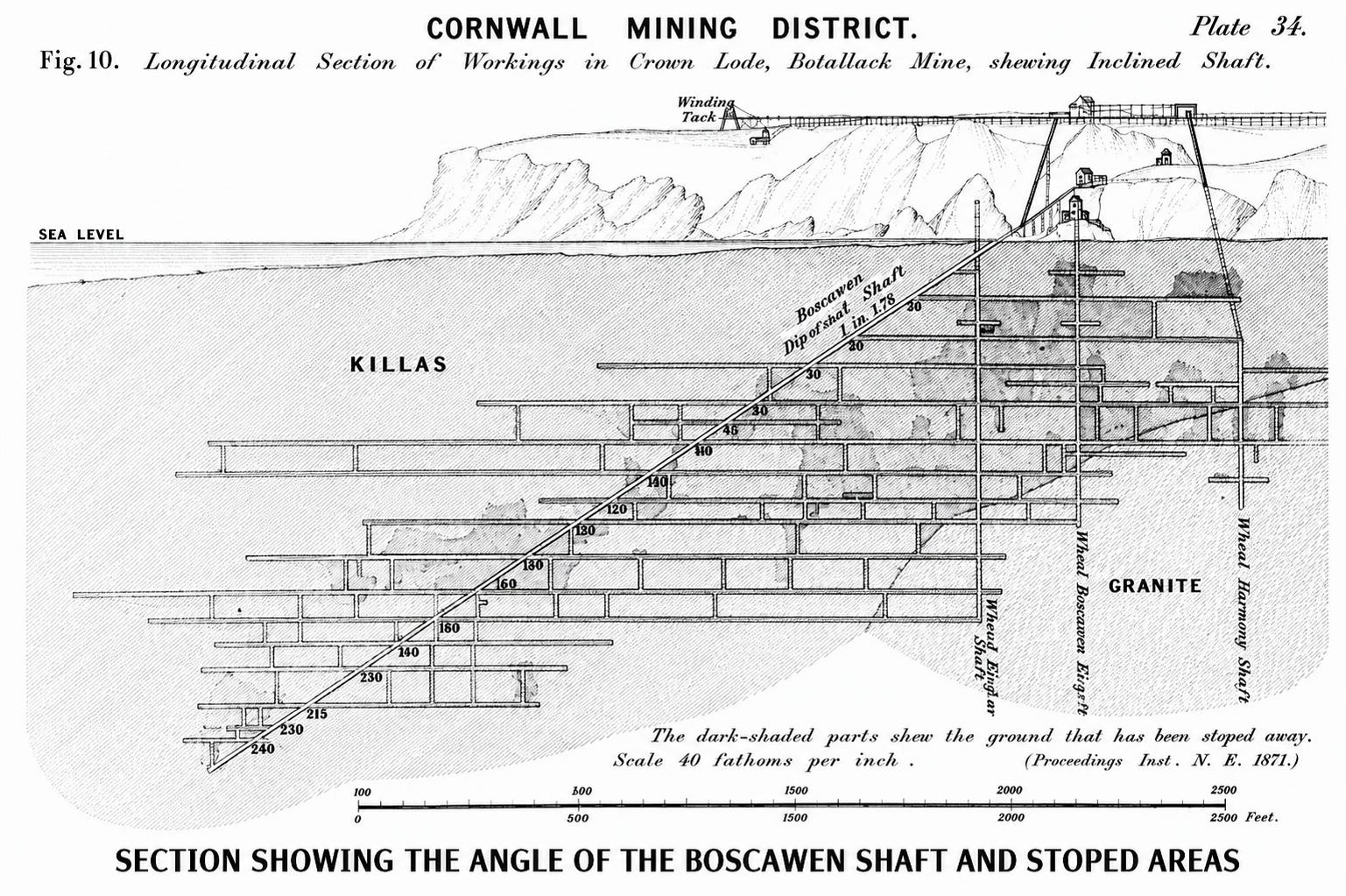
Standing on the cliffs, the view is breathtaking.
Standing underground was something else entirely. The mines were hot, dark, wet, and dangerous. Miners often spent ten to twelve hours underground. Flooding, rock falls, explosions, and equipment failures were constant threats.
Yet the greatest dangers were often invisible.
The Diseases of Progress
Mining was among the most hazardous occupations of the nineteenth and early twentieth centuries.
The most familiar threat was silica dust. Drilling, blasting, and crushing rock released microscopic particles that accumulated in the lungs, producing silicosis—a progressive and often fatal disease.
But silicosis was only part of the story.
Many Cornish miners also died from tuberculosis. For years, the relationship between mining and tuberculosis was poorly understood. Today we know that silica damages the lungs and impairs immune defenses, increasing susceptibility to tuberculosis. The resulting disease, known as silicotuberculosis, was particularly devastating.
Silica exposure increases the risk of tuberculosis by roughly 3- to 30-fold, depending on the intensity and duration of exposure, making silicosis one of the strongest known risk factors for TB. The association has been recognized for more than a century.
The mines themselves amplified these risks. Miners worked for long hours in crowded underground spaces with poor ventilation, conditions that facilitated the transmission of tuberculosis from one worker to another.
Together, silica, tuberculosis, and poor working conditions created a perfect storm of occupational disease.
Life expectancy among miners was often substantially shorter than that of the general population.
The Great Cornish Migration
As Cornwall’s mines declined during the nineteenth century, another remarkable story unfolded.
Cornish miners carried their expertise around the globe.
An estimated quarter of a million Cornish people emigrated during the nineteenth century. Many became known as “Cousin Jacks,” skilled miners who could be found in Australia, South Africa, Mexico, Chile, Canada, and the United States.
Wherever valuable minerals were discovered, Cornish miners often followed.
They brought technical expertise, mining traditions, engineering knowledge, and a distinctive culture. Their influence remains visible today in communities from Michigan’s Upper Peninsula to the copper mines of Australia and the gold fields of South Africa.
In many ways, Cornwall exported not just miners but an entire industrial culture.
Geevor’s Final Shift
The last chapter of Cornish mining ended surprisingly recently.
Geevor Tin Mine closed in 1990, marking the end of large-scale commercial tin mining in Cornwall. For many visitors, 1990 feels almost contemporary. The machinery, offices, and changing rooms still look familiar.
Walking through Geevor, I was struck by how quickly an industry that once shaped the world can disappear.
Nowhere was that more apparent than in the Dry, where generations of miners changed before and after their shifts. The room remains much as it was left when the mine closed. Hundreds of lockers stand in neat rows. Many are still half-open. Some contain old work clothes, boots, photographs, handwritten notes, and other personal belongings. Shirts and trousers still hang from overhead pipes where miners once dried their clothes after long days underground. A fine coating of red dust settles over everything.
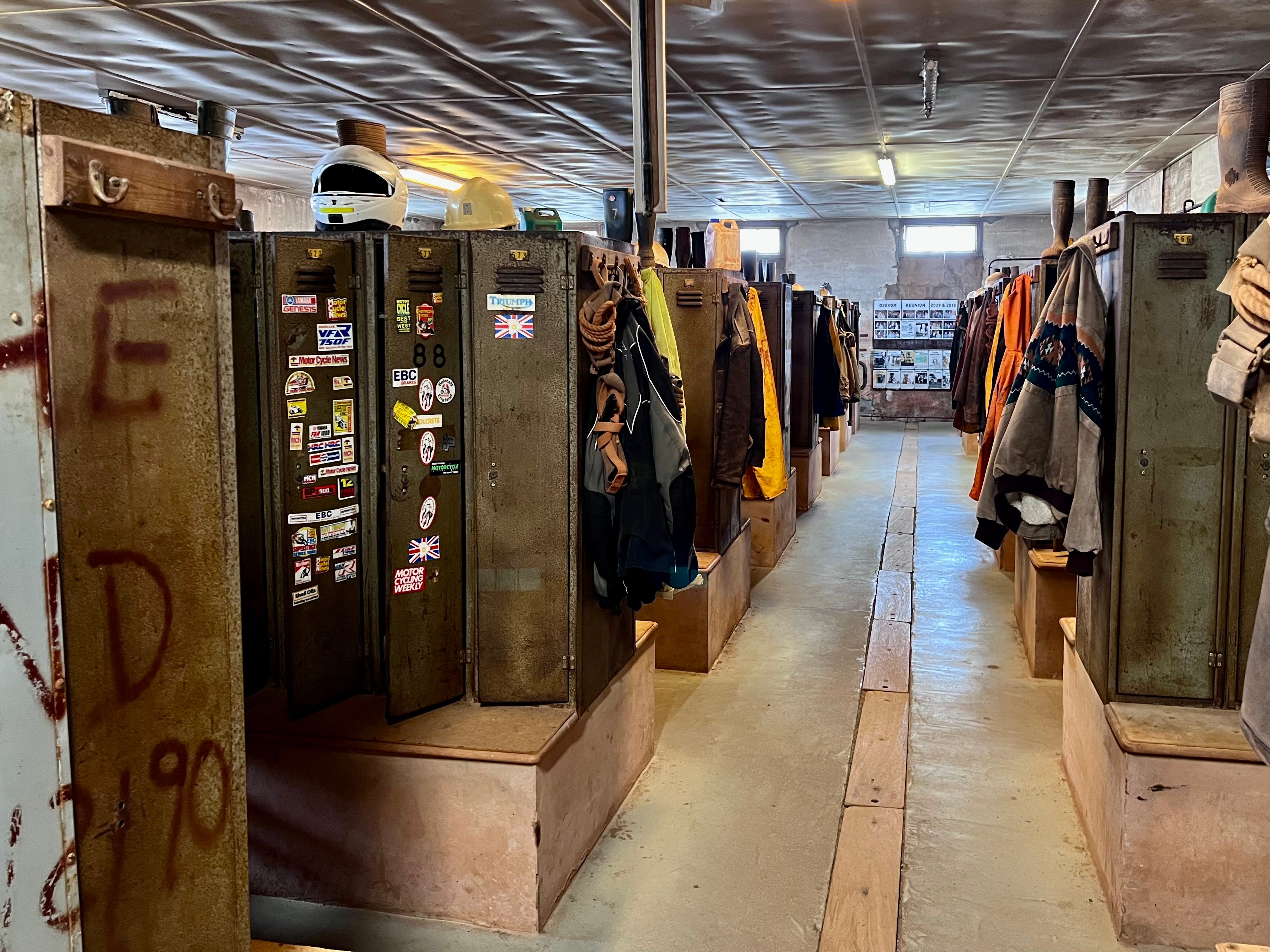
More than any engine house or piece of machinery, the Dry brought the mine to life. These were not anonymous workers in a history book. They were fathers, sons, brothers, husbands, and friends. The photographs, notes, and worn clothing offered fleeting glimpses into lives shaped by hard work, camaraderie, and pride in a profession that helped build the modern world. Standing among those lockers, it was impossible not to think about the many miners whose lives were shortened by injuries, silica dust, tuberculosis, and other hazards of the job. The mine had closed, but traces of the people remained—as if they had simply stepped away at the end of a shift and never returned.
Within a single lifetime, Cornwall went from supplying critical materials for industrial civilization to preserving its mines as museums.
Yet the mines remain relevant because they tell a larger story.
One might hope that the lessons of Cornwall’s mines were learned long ago. Yet silicosis is re-emerging among a new generation of workers who cut and polish engineered stone countertops, often marketed as “quartz.” In California alone, more than 550 workers have been diagnosed with silicosis, over 100 have undergone or are awaiting lung transplantation, and dozens have died. Similar outbreaks have been reported in Australia, Spain, Israel, Britain, and elsewhere. The names of the industries have changed, but the underlying story remains familiar: a profitable product, inadequate protections, delayed recognition of harm, and workers paying the price.
That is why places like Geevor matter. They remind us that occupational diseases are not relics of the Industrial Revolution. The technologies change. The products change. But unless we remain vigilant, the pattern repeats itself. The dust that scarred the lungs of Cornish miners more than a century ago continues to claim victims today.
What We Choose Not to See
Public health often asks a simple question: Who bears the costs of progress?
The miners of Cornwall helped build the modern world. Their labor produced materials that improved living standards, fueled technological innovation, and contributed to unprecedented economic growth. At the same time, many paid a steep price through disease, disability, and shortened lives.
The lesson is not that mining was bad. Without mining, modern society would be unimaginable. The lesson is that progress has always involved trade-offs. The benefits are often widely distributed, while the harms are concentrated among workers, communities, and future generations.
We face similar questions today with air pollution, toxic chemicals, climate change, and other environmental hazards. We enjoy the benefits while often overlooking the costs.
Perhaps that is why I found Cornwall’s mines so compelling.
They are not merely relics of the Industrial Revolution. They are reminders that every era creates its own balance between prosperity and health. The challenge for public health is not to reject progress, but to ensure that its benefits do not come at the expense of those whose sacrifices remain hidden beneath the surface.
The miners of Cornwall paid a price that was seldom reflected in company ledgers or national accounts. Their stories remind us that wealth is often built on risks borne by others. Honoring their sacrifice requires more than preserving engine houses and mine museums. It requires the courage to enact regulations, enforce protections, and hold corporations accountable so that future generations of workers are not asked to sacrifice their health—and sometimes their lives—at the altar of profit.
Standing above the ruins of Botallack and Trewavas, watching waves crash against cliffs that once echoed with steam engines and miners’ voices, it was impossible not to feel a sense of admiration.
The miners helped build the modern world.
The least we can do is remember what it cost.
Oh my! I read this posting out loud to my 2 neighbors as we drank coffee together yesterday morning. Hearing the words out loud brought tears of memories and new understandings. Back in the 70s I worked in a hospital in Indiana where we were treating patients with Black Lung disease. If my ancestral line comes through Cornwall, I’m likely y to carry some of the particles that caused those illnesses back in the day. And, of course, some of my tears are tears of joy and gratitude when I read Bruce’s
articles, full of situations, compassion, adventure, curiosity, poetry, discovering how humans have struggled over the centuries
I was struck by how many lives have been affected by mining. As a pediatrician, I found myself wondering about the children and women who worked above ground. I wondered why in so many images, no protective ear, eye, or nose/mouth protection was visible.
The individuals we met who worked at the desk or led the tours all had ancestors who had worked at Geever. There was a pride for the work and a desire to have others know their history. They also noted the loss of health, fertility, and illness. The red dust from the work gave workers skin a false impression of health.
My sense was that the workers were the ones responsible for preserving their history, not the owners. My cynical thought is that the owners have moved on and don't choose to remember.