
Why Disease Isn’t Written in Our DNA
What heritability gets wrong—and prevention gets right


How We Mistook Inevitability for Evidence
Every few months, a familiar headline resurfaces, dressed up as a fresh discovery: “Genes explain 50%—sometimes even 80%—of X.” Life expectancy. Intelligence. Autism. Obesity. Pick your condition.
The number changes. The implication does not.
It suggests that what we’re seeing—rising disease, disability, shortened lives—is largely written into our DNA. Unfortunate, perhaps, but inevitable. And if it’s inevitable, there’s little to be done beyond better drugs, better genetic testing, and more patient acceptance.
Recently, a high-profile article in Science revived this storyline, arguing that when accidents and infections are mathematically set aside, the heritability of a redefined, “intrinsic” lifespan rises to roughly 50%. The conclusion was framed as a revelation: we’ve underestimated heritability all along.
But despite the language of lifespan, the analysis is really about life expectancy—variation in age at death within a population, driven largely by chronic diseases, under selectively defined conditions—not the biological limits of human life.
That distinction matters.
Because it raises a puzzle that should give us pause: if genes explain so much, why did heart disease, diabetes, dementia, and cancer surge over the past century—while our genes barely changed at all?
That question is where the heritability story begins to unravel.
The Seductive Clarity of Heritability
Heritability is an oddly comforting statistic. It has a crisp number attached to it. It sounds precise. Scientific. Authoritative. But heritability does not mean what most people—including many journalists, physicians, and scientists—think it means.
A heritability estimate does not tell us how “genetic” a disease is. It does not tell us whether a condition is preventable. And it certainly does not tell us whether changing the environment would matter.
It simply describes how much variation in a trait exists within a specific population, at a specific time, under a specific set of environmental conditions. Change the environment, and heritability changes—even if the genes do not. That’s not a flaw in genetics. It’s a flaw in how we talk about it.
Twin Studies: Elegant, Limited, and Too Often Overinterpreted
Much of our modern obsession with heritability traces back to twin studies. The logic is seductively simple. Identical twins share essentially all their genes; fraternal twins share fewer. Compare their outcomes, run the statistics, and—voilà—you get a heritability estimate.
The problem is not that twin studies are useless. The problem is that they are asked to answer questions they cannot possibly answer.
Twin studies rarely measure environmental exposures in any meaningful way. They do not track air pollution, lead, pesticides, endocrine disruptors, infections, nutrition, stress, poverty, or housing quality. Instead, they rely on a critical assumption: that twins experience “equal environments.” It’s a heroic assumption—especially outside the controlled imagination of a statistical model.
Modern epigenetics exposes just how fragile this assumption is. Genetically identical individuals diverge biologically as their lived environments diverge. Epigenetic marks—chemical tags that help turn genes on or off—record exposures, stressors, diet, illness, and adversity. When environments go unmeasured, their effects don’t vanish. They are quietly reassigned—absorbed into the genetic column. What looks like “hidden heritability” is often unmeasured environment in disguise.
Crucially, this divergence begins before birth. Genome-scale analyses show that monozygotic twins are already epigenetically distinct at delivery. These differences are driven largely by nonshared intrauterine influences and the chance variation inherent to early development—not by genetics. Even under identical genetic and maternal conditions, small differences in cellular timing and gene regulation can produce lasting biological divergence.
Heritability estimates that assume equivalent early environments therefore embed unmeasured exposures into genetic variance from the very start—at a uniquely vulnerable period of development. This is not a minor technical footnote. It is the central problem.
When environmental factors aren’t measured, they don’t disappear. They simply get counted as genes.
When Environment is Erased by Definition
In the recent life expectancy article, the authors take an additional conceptual leap. They divide deaths into two categories:
Extrinsic deaths: accidents, infections, violence
Intrinsic deaths: everything else
They then mathematically remove extrinsic deaths and conclude that what remains—heart disease, cancer, dementia—is largely genetic.
But this framing quietly performs a sleight of hand.
Heart disease is not “intrinsic” in the sense implied. Neither is dementia. Nor most cancers. These conditions are deeply shaped by environmental exposures—air pollution, toxic metals, smoking, diet, occupational hazards, and social conditions that structure risk from before birth onward.
By redefining environmentally driven diseases as “intrinsic,” the analysis does not discover genetic causation. It relabels environmental causation.
That is not correction. It is reassignment.
When Bad Environments Make Genes Look Powerful
Obesity offers an unusually clear window into how genes and environment interact. One study, published in JAMA Pediatrics, asked a deceptively simple question: does the heritability of body mass index depend on the environment a child grows up in?
To answer it, researchers studied nearly 2,000 four-year-old twins in the UK and did something most heritability studies do not: they measured the environment directly. Using detailed interviews, they classified each child’s home as more or less obesogenic—based on food availability, opportunities for physical activity, and screen exposure.
The results were striking.
In lower-risk homes—where healthier foods were available and children had more opportunities to be active—the heritability of BMI was modest, about 40%. Shared environmental factors explained much of the remaining variation.
In high-risk, obesogenic homes, heritability soared to nearly 90%. The contribution of shared environment nearly disappeared.
Genetically similar children. Same genes. Radically different heritability estimates.
The Heritability Paradox
In healthier settings, environmental supports buffered vulnerability, keeping children’s outcomes more similar regardless of genotype. In harmful settings, those buffers vanished, allowing small biological differences to widen into large disparities in weight.
This is the heritability paradox: the worse the environment, the more “genetic” a condition can appear.
High heritability, in this context, is not evidence that obesity is genetically determined. It is evidence that the environment has become sufficiently adverse that genetic vulnerability is allowed—forced—to express itself.
Once you see this, the broader fallacy of heritability becomes hard to miss. Heritability does not tell us how inevitable a condition is, or how unchangeable it may be. It tells us something much narrower: how differences appear within a population under a given set of conditions.
When environments deteriorate—through poor diet, chemical exposures, chronic stress, or social deprivation—heritability estimates often rise. The mistake is to read that rise as proof that genes are driving disease, rather than as a warning that we have engineered conditions that magnify vulnerability.
Obesity makes this visible because the environment is familiar and tangible. But the same logic applies to autism, diabetes, mental health conditions, and even life expectancy. As protection erodes, genetic susceptibility appears to loom larger—not because biology has changed, but because the environment has.
Seen this way, heritability is not a verdict on destiny. It is a diagnostic of environment.
The Historical Amnesia Built into Heredity Talk
One of the strangest features of modern heritability claims is how quickly we forget history. Coronary heart disease was rare a century ago. Autism diagnoses were uncommon. Obesity rose sharply within a single generation. Parkinson’s disease was once a medical curiosity.
Did we suddenly mutate as a species?
Or did we radically alter the environments in which brains, arteries, and other organs develop?
When lead was removed from gasoline, heart attacks declined. When air pollution fell, cardiovascular deaths dropped within months. When smoking rates fell, lung cancer followed.
None of these victories required gene therapy.
Why the Heredity Narrative Persists
So why does the genetic framing persist so stubbornly?
Partly because it is intellectually tidy. Partly because it aligns with biomedical training. And partly because it is politically convenient—and profitable. Genetic explanations rarely trigger regulation, lawsuits, or liability. Environmental causes do.
If disease is genetic, responsibility shifts from systems to individuals. From policy to personal fate. From prevention to treatment.
That is not a neutral outcome.
A Better Question to Ask
Instead of asking, “How heritable is this condition?”
We should ask:
What changed in the environment before the disease rose?
When exposures are reduced, does disease decline?
Are there critical windows—fetal life, early childhood—when harm is amplified?
Do safer alternatives already exist?
These are the questions that built modern public health.
They are also the questions heritability talk too often obscures.
Genes Matter. Just Not the Way We Pretend.
None of this is an argument against genetics. Genes matter. They shape susceptibility. They influence resilience. They help explain why the same exposure harms one person more than another.
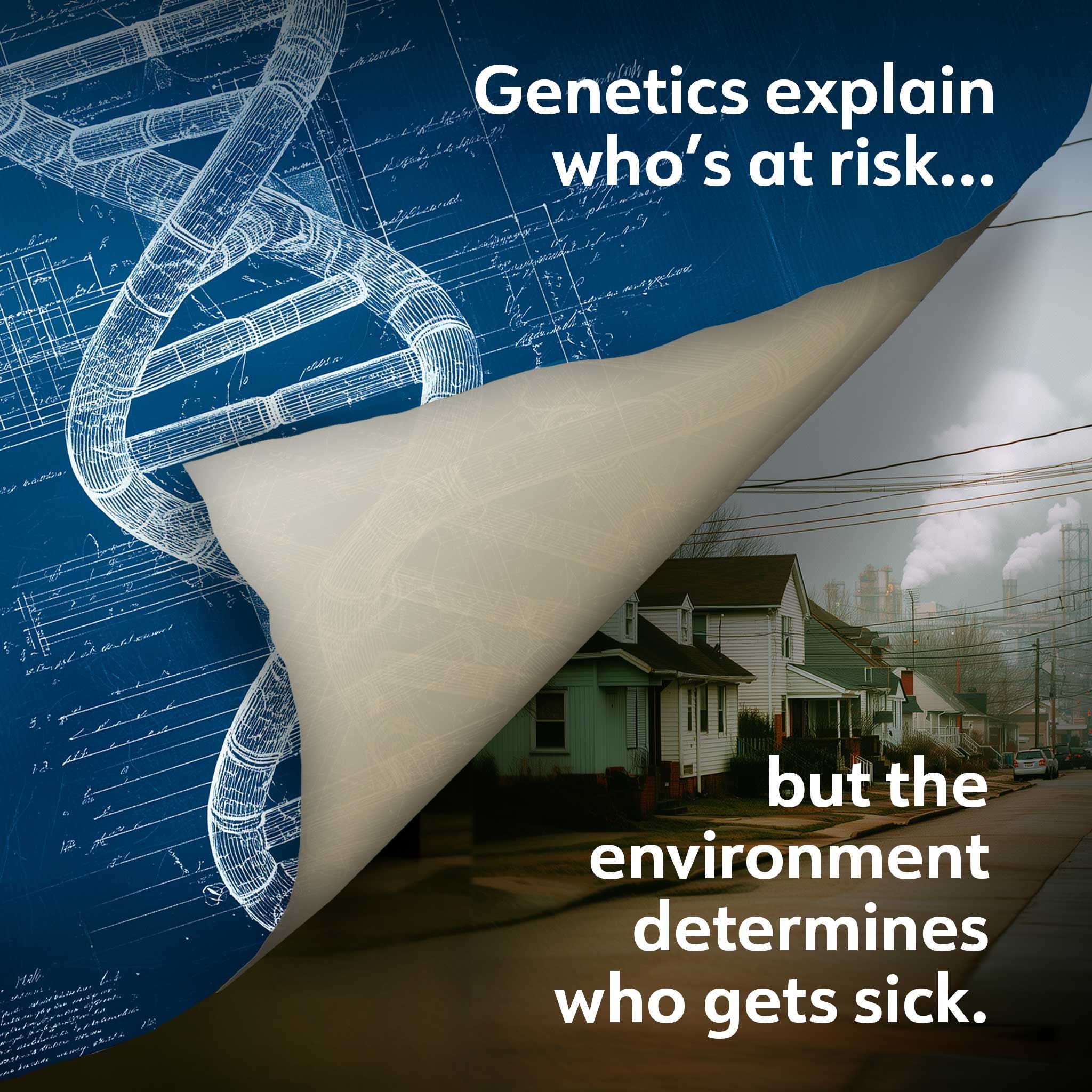
What genes don’t do is explain why entire populations get sick all at once. For answers at the population level, we have to look outward, not inward.
Time to Retire a Misleading Shorthand
It is time—long past time—to stop using heritability as a conversational shortcut for causation. It confuses journalists, misleads the public, and muddies scientific discourse.
Worse, it distracts us from the most hopeful truth in public health:
Many of today’s chronic diseases are not inevitable. They are preventable.
We know this because we have already prevented some of them—by changing environments, not genomes.
That is not a pessimistic story. It is a profoundly optimistic one.
And it is the story we should be telling.
Superb piece. The obesogenic study realy flips the usual framing. I've always thought higher heritability meant more genetic inevitability, but watching how the same twins show different heritability based on their home environment makes it obvious that the environment is the variable doing the work. The distinction betwene intrinsic and extrinsic deaths is such a clean example of reassignment logic.
Thanks Bruce, for opening my eyes once again, to be able to see hidden connections I had no idea were there.
My two favorite lines
"Genetics explain who’s at risk, but the environment determines who gets sick."
"Many of today’s chronic diseases are not inevitable. They are preventable." (this line I will quote in an oped, thanks)