
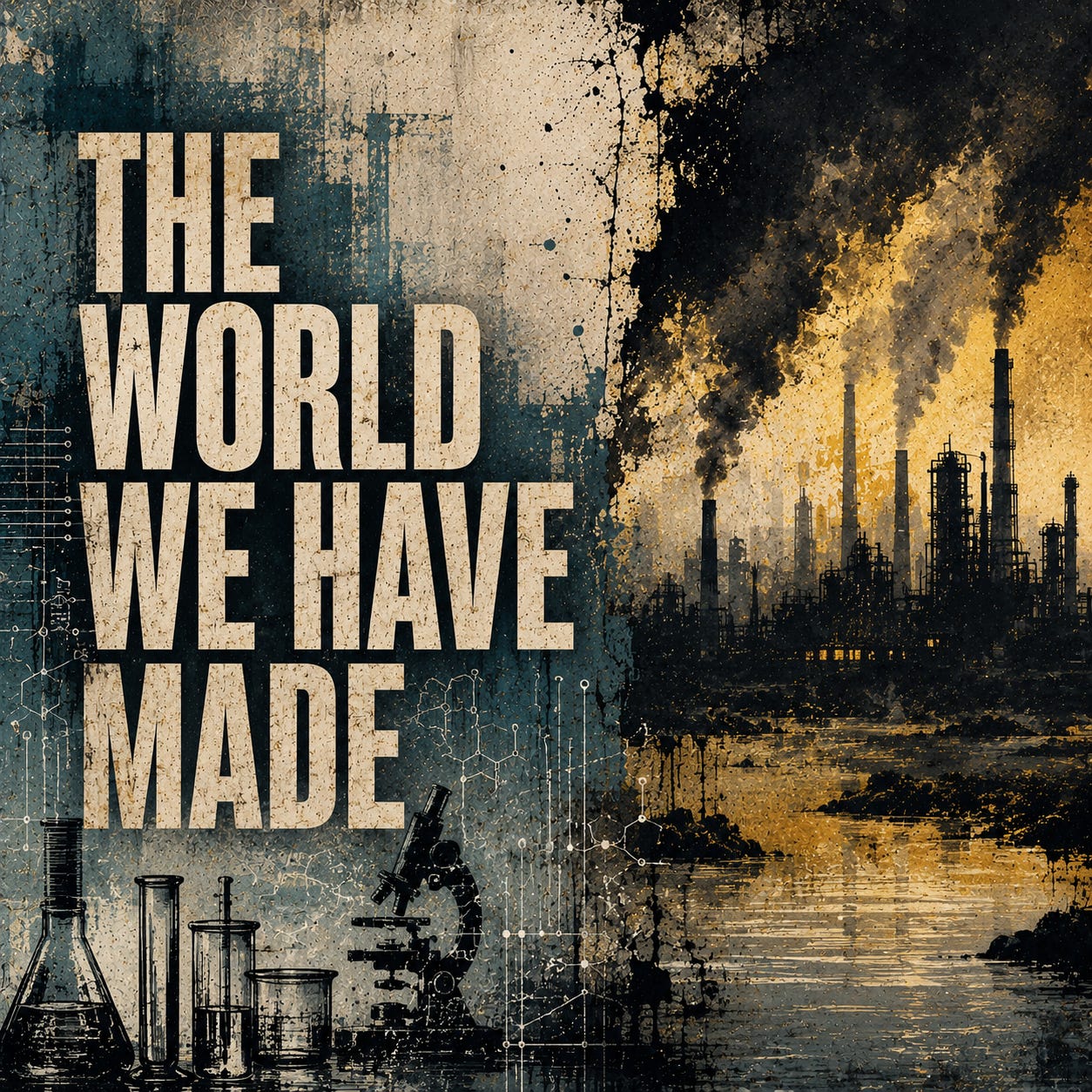
The World We Have Made

David Rosner and Jerry Markowitz taught generations of historians, physicians, and public health scientists to look beyond individual choices and ask a harder question: What kind of world have we built?
That question lies at the heart of their book Building the Worlds That Kill Us. It also lies at the heart of this poem and much of my own work.
I share it here in memory of David Rosner, who died this past week. Few people did more to help us understand that disease is often woven into the environments, institutions, and products we create—and then come to accept as normal.
The scientists in white coats
fill the laboratories
in droves,
searching for the cure.
Many go gladly,
moved by suffering,
uplifted by the promise of technology,
hopeful as people who still believe
suffering can be mended.
They search the blood,
the gene,
the misfolded protein,
certain that somewhere
inside the machinery of life
a broken part waits
to be repaired.
And sometimes they succeed.
A child survives leukemia.
A failing heart beats longer.
Pain loosens its grip
for another season.
But the promise of a cure
can become its own distraction,
keeping us from asking
why the same harms
return generation after generation.
As one epidemic recedes,
another arrives quietly
through the same door
that delivered the last round of progress.
The new solvent.
The new pesticide.
The smoke from the tailpipe.
The coating that does not stick.
The plastic that does not break.
And behind them all,
the factories hum,
the markets climb,
the shareholders gather,
pleased that production
was up again this quarter.
The diagnosis comes later.
Years after the dust settles.
Years after the contract is signed.
Years after the product
has become ordinary.
We have built an economy
that rewards production
more than protection.
We leave our mark upon the world
and forget
how deeply it leaves its mark on us.
Protection asks something harder of us.
Not brilliance alone,
but restraint.
Not another cure
arriving after the damage,
but the wisdom
to stop poisoning ourselves
in the first place.
Yet there is too little profit
in the child who never becomes sick,
the illness that never comes.
So we continue
our endless and noble search
for cures,
forgetting that disease
is often less a mystery
than a mirror—
reflecting the world
we have made.
"We have built an economy
that rewards production
more than protection."
What we have created indeed, good food for thought Bruce.
Minor pain and discomfort that flare up on an irregular schedule are signs of that world and that our body tells us is not normal as it struggles to heal its effects, adapt to the trouble we cause the metabolic dysfunction we visit upon it
Prevention is definitely the key to be illness free, a healthy lifestyle: organic food, escaping city living, sound sleep, moderately strenuous exercise, movement, lower, normal stress levels, can reverse the illness train wreck.
Sometimes even in advanced stages of an illness: our body is a miracle that wants to heal and stay healthy, but sometimes it tells us enough is enough and its non physical part escapes into the universal energy of which it has been part of from its beginning
Peace and harmony